
Hi there! I am an after-sales technical engineer, and I’m thrilled to share our deep expertise on high-end 5 Axis CNC Routers with you.
When I first saw a 5 axis CNC router in operation, I was completely fascinated. The machine moved with such precision and grace, carving out complex 3D shapes as if it were sculpting effortlessly in air.
Over the years, as I’ve worked with various CNC systems—from simple 3 axis routers to advanced 5 axis machining centers—I’ve learned that technology like this is not just about cutting material; it’s about redefining what’s possible in modern manufacturing.
If you’ve ever wondered what makes a 5 axis CNC router so special, how it works, and whether it’s worth investing in, this comprehensive guide will walk you through everything you need to know.
I. What is a 5 Axis CNC Router?
In its simplest form, a CNC Router uses computer numerical control to cut, shape, and mill materials automatically.
Traditional 3 Axis CNC router machines operate across three linear directions:
- X-Axis: Left-to-right movement (Lateral).
- Y-Axis: Front-to-back movement (Longitudinal).
- Z-Axis: Up-and-down movement (Vertical/Depth).
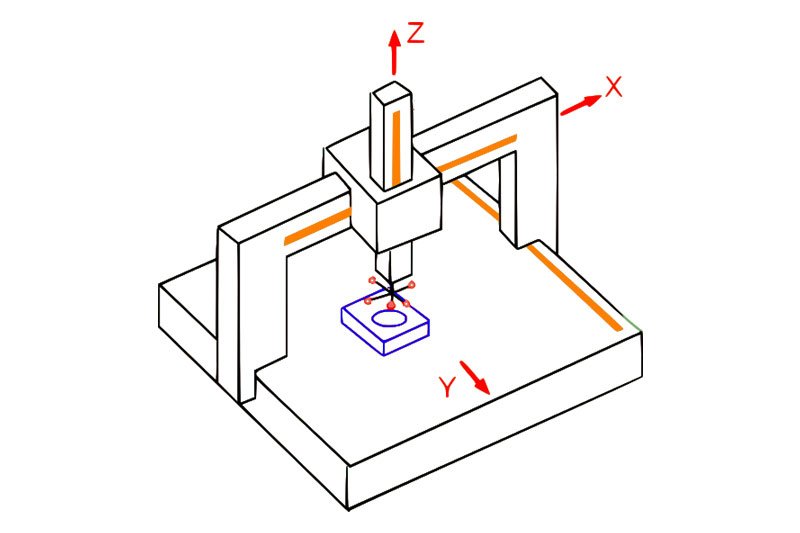
A 5 Axis CNC Router takes this capability to the next level by adding two rotational axes. These extra axes allow the cutting tool to approach the workpiece from virtually any angle.
5 Axis = 3 Linear Axes (X, Y, Z) + 2 Rotational Axes (A, B, or C)
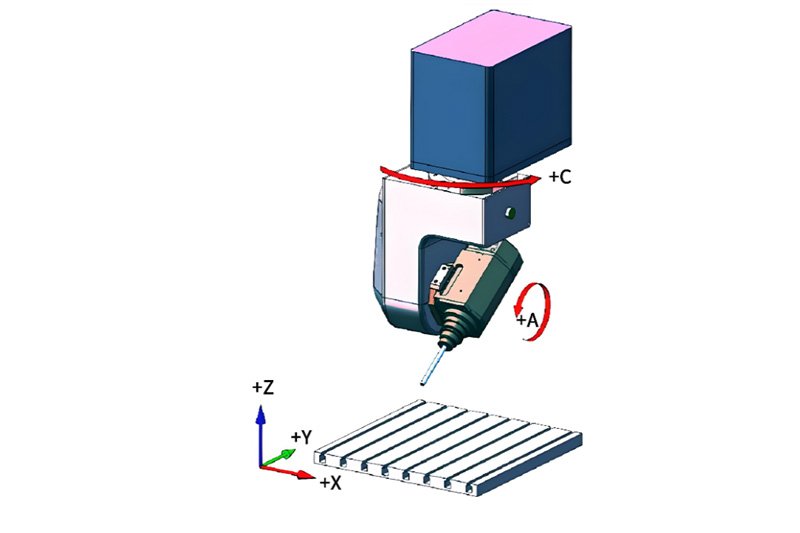
This isn’t just an incremental improvement; it’s a quantum leap. Think of a human arm: a 3-axis machine is like a shoulder moving in three directions. A 5-axis machine adds the flexibility of the wrist and elbow, allowing you to reach and machine any point on a complex object with ease.
II. How Does a 5 Axis CNC Router Work
The magic of a 5-axis machine lies in the coordinated movement of all five axes simultaneously. This is achieved through highly advanced mechanical setups:
1. Spindle Head Movement (Tool-Side Rotation)
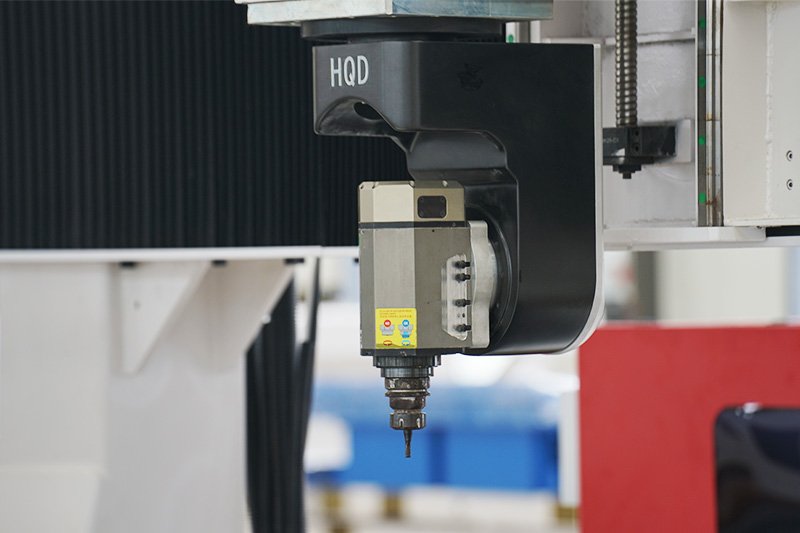
In this configuration, the cutting spindle itself can rotate or tilt along two axes.
- Example: A-axis (rotation around X) and C-axis (rotation around Z).
- Advantage: This allows for the use of shorter, more rigid tools, which minimizes vibration and improves surface finish quality.
2. Worktable Movement (Workpiece-Side Rotation)
The workpiece is clamped onto a turntable or trunnion structure that can rotate and tilt.
- Example: Rotation around the X-axis (A-axis) and the Y-axis (B-axis).
- Advantage: Ideal for machining heavier, bulkier parts where moving the spindle head might be less rigid.
- The Brain: CNC Controller and RTCP. The sophisticated CNC Control System (like Siemens, Fanuc, or Syntec) coordinates these movements in real-time.
- Simultaneous Machining: All five axes move together to follow complex toolpaths for continuous contouring.
- Real-Time Tool Center Point (RTCP): High-end Blue Elephant models feature RTCP. This critical algorithm automatically compensates for the rotation and pivot length of the tool, ensuring the tool-tip position remains exactly where programmed, regardless of the tool’s angle. This is the secret to unparalleled accuracy on intricate surfaces.
The following video demonstrates the working principle of a 5-axis CNC engraving machine:
III. 5-Axis CNC Router Advantages
If you’re serious about high-quality, high-volume production, the 5-axis CNC router is your competitive advantage.
| Advantage | Why It Matters to Your Business |
| Superior Precision | Eliminates cumulative errors from multiple setups. Feature-to-feature accuracy is maintained because the part is fixtured only once. |
| Single Setup Efficiency | Machine up to five sides of a part without manually repositioning. This slashes setup time and dramatically reduces your overall cycle time. |
| Exceptional Surface Finish | The tool can maintain an optimal cutting angle (tangential) to the surface, allowing for smoother cuts and reducing or eliminating the need for costly post-machining hand finishing. |
| Complex Geometry Capability | Easily manufacture complex contours, deep cavities, helical features, and undercuts that are impossible with 3-axis machines. |
| Optimized Tool Life | Cutting tools can approach the material at ideal angles, distributing wear evenly and allowing the use of shorter, more robust tools. This means less tool breakage and lower consumables costs. |
IV. High-Performance CNC 5 Axis Router Features
Blue Elephant engineers our machines with core components that ensure reliability and performance:
- High-Rigidity Structure: A heavy-duty, stress-relieved steel frame is crucial to absorb vibration and maintain geometric accuracy during high-speed, dynamic movements.
- Premium Spindle: Powerful, liquid-cooled, high-speed spindles (often from Italian brands like HSD) designed for continuous, multi-angle operation.
- Advanced Servo Drives: High-resolution servo motors and high-precision linear guides and gear racks (or ball screws) on all five axes to ensure smooth, rapid, and exact positioning.
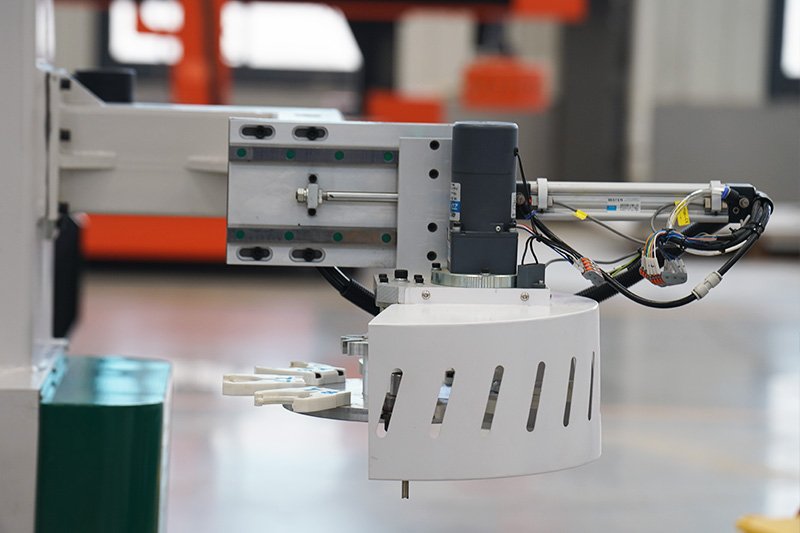
- Automatic Tool Changer (ATC): A large-capacity ATC system allows the machine to switch tools quickly and autonomously, maximizing true unattended production time.
- Precision Calibration: Every Blue Elephant 5-axis machine undergoes rigorous laser calibration to ensure the rotational axes are perfectly aligned for superior volumetric accuracy.
V. 5 Axis CNC Router Machine Types
To serve the diverse needs of our global customers, Blue Elephant offers structures tailored for specific applications:
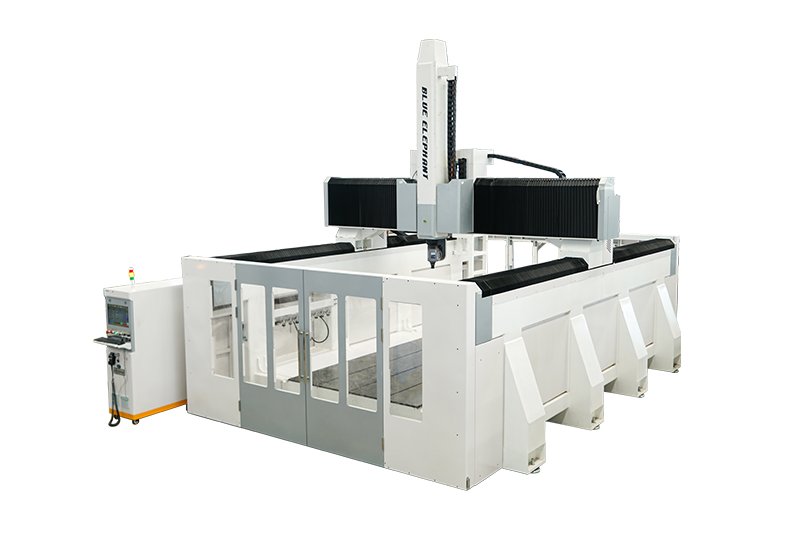
1. Heavy-duty Axle Type 5 Axis CNC Router
The below heavy-duty axle type 2040 5 axis CNC router machine is an advanced and new design Blue Elephant EPS CNC foam cutter with 5 axis head for Sale. It is equipped with various good-quality and high-performance parts to guarantee stable and precise processing.
Best For
• Large-format machining: Perfect for processing oversized panels, molds, and complex 3D parts with precision and stability
• Multi-material versatility: Handles wood, foam, resin, aluminum, and composite materials with ease.
• Industrial-grade production: Designed for factories and workshops that require continuous, high-efficiency 5 axis machining.
• Complex surface processing: Excellent for aerospace components, automotive molds, and artistic 3D sculptures needing smooth, accurate contouring.
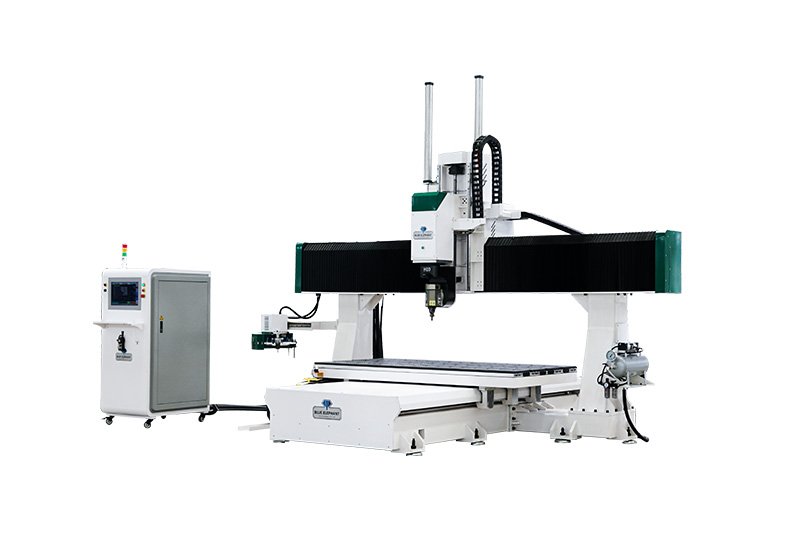
2. Lightweight Tabletop Mobile 5-axis CNC Router(Single/dual station)
The following ELE1325ATC-5 EW1 Moving Table 5 Axis CNC Router(single station), is convenient for mobile processing, suitable for processing small products, with strong load-bearing capacity and more sturdy.
Best For
• Precision prototyping: Ideal for designers, educators, and R&D teams who need accurate small-scale models or test parts.
• Compact workshops: Perfect for studios or labs with limited space that still require advanced 5-axis machining capability.
• Flexible production: It can cut and engrave wood, acrylic, PVC, resin, foam, EPS, MDF, plaster, plexiglass, soft metals, and more.
• Lightweight materials: Excellent for machining wood, foam, plastic, and soft metals in creative, educational, or technical applications.
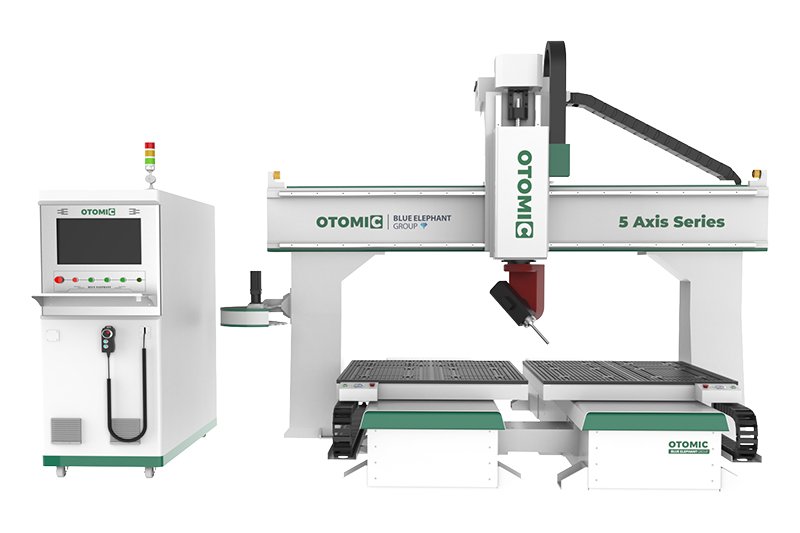
3. Heavy-duty Tabletop Mobile 5-axis CNC Router (Single/dual station)
EW1 5 axis CNC router with two tables can reduce non-productive time by processing at one table while unloading at the other. This greatly improves work efficiency. It is widely used to process 3D wood, foam, and plaster molds, statues, and parts.
Best For
• Continuous production: Perfect for workshops that need non-stop machining—one table can be loaded while the other is cutting.
• Dual-station efficiency: It can process at one table while unloading at the other, which reduces idle time between operations.
• Precision manufacturing: Suitable for producing complex, multi-surface parts with high dimensional accuracy and smooth finishes.
• Diverse materials: Handles wood, foam, resin, and composite panels commonly used in furniture, mold making, and aerospace industries.
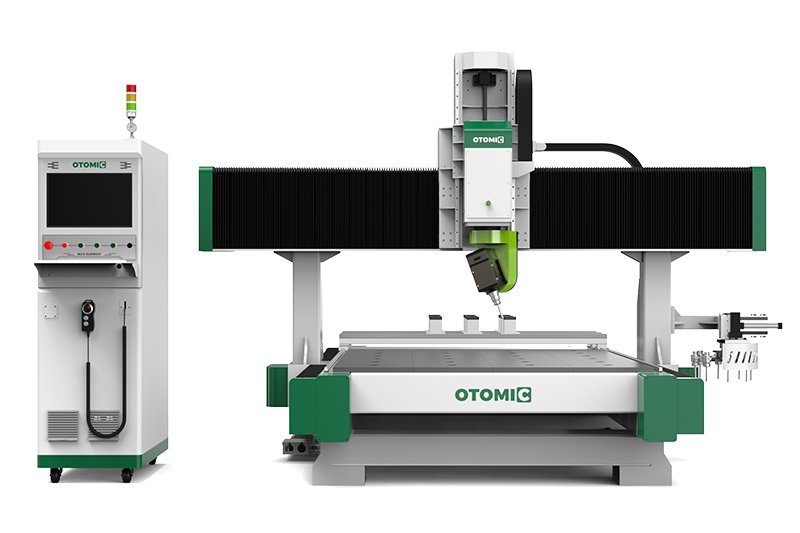
4. Moving Column Gantry Type 5-axis Machining Center
EW3 5 axis CNC router with moving column gantry adopts a dynamic column structure. That means the workpiece is fixed on the workbench, and the column and gantry move along the direction of the bed. Therefore, it can provide larger processing space and higher stability.
Best For
• Large-scale machining: Perfect for processing massive components such as molds, dies, and structural parts with exceptional stability and accuracy.
• Heavy-duty materials: Suitable for cutting aluminum, steel, composites, and other hard materials used in industrial manufacturing.
• Precision engineering: Ideal for aerospace, automotive, and energy sectors that demand high dimensional accuracy and complex geometries.
• Continuous production: Designed for factories requiring reliable, high-speed 5-axis performance in long-term, high-volume operations.
VI. The Investment Choice: 3 Axis vs. 4 Axis vs. 5 Axis
| Feature | 3 Axis CNC Router | 4 Axis CNC Router | 5 Axis CNC Router |
| Axes & Linkage | X, Y, Z (3-axis simultaneous) | X, Y, Z + 1 Rotational (3+1 linkage) | X, Y, Z + 2 Rotational (5-axis simultaneous) |
| Capability | Flat panels, basic 3D engraving (2.5D) | Cylindrical turning, edge machining, side drilling | Complex contours, deep undercuts, multi-face machining |
| Setup Time | High (frequent manual flips required) | Medium (cylindrical parts often single setup) | Lowest (single setup for almost all parts) |
| Precision | Basic (prone to accumulated re-fixturing errors) | Good | Highest (RTCP ensures continuous accuracy) |
| Best For | Cabinetry, basic signage, flat stock cutting | Columns, stair railings, furniture legs, simple molds | Aerospace, high-end automotive molds, complex prototyping, sculpting |
The Bottom Line: If you pursue high-quality, automated, and versatile production, the 5-axis machine is not a luxury—it’s an essential business tool that unlocks higher-value contracts.
Read this article to learn more about the secrets of 3-axis, 4-axis, and 5-axis CNC router machines:
VII. Understanding 5 Axis Router Investment and Cost
The initial investment for a high-quality 5-axis CNC router is significantly higher than 3-axis or 4-axis models, but it’s a strategic cost that offers substantial returns.
Entry-level models for prototyping or educational use typically cost $40,000–$70,000, mid-range industrial machines range from $80,000–$150,000, and heavy-duty machines for high-volume production may exceed $200,000–$300,000.
Key factors influencing the price include:
- True 5-Axis Linkage vs. 3+2 Positioning: True simultaneous 5-axis movement requires advanced software and controllers (and is more expensive) than 3+2 positioning, where the two rotary axes lock into position before 3-axis cutting begins.
- Controller and Component Quality: Premium brands like Siemens, Fanuc, or highly functional systems with RTCP are a major cost factor but guarantee long-term reliability and precision.
- Machine Size and Customization: Larger working envelopes and specialized features (e.g., automated safety barriers, mist coolant systems) increase the price.
- Less Labor: Fewer setups mean less operator time is spent aligning parts.
- Reduced Scrap: Higher precision drastically reduces the rate of rejected parts.
- Market Expansion: The capability to produce complex, tight-tolerance parts opens doors to lucrative high-tech industries.
- Actionable Insight: The time and money saved by reducing finishing work and setup time often make the long-term operational cost of a 5-axis machine lower than a fleet of 3-axis machines.
VIII. 5 Axis CNC Router Industries and Applications
The 5-axis router is the workhorse behind modern manufacturing excellence:
1. Furniture Manufacturing
• Custom and luxury furniture: 5 axis CNC routers are widely used to create high-end solid wood furniture, including curved tables, artistic chairs, and decorative cabinets with complex 3D surfaces.
• Seamless contour cutting: The ability to process multiple angles in one setup eliminates manual sanding and hand finishing.
• Mass customization: Manufacturers can efficiently produce personalized furniture designs while maintaining precision and repeatability.

2. Cabinet and Door Production
• Intricate panel designs: Perfect for making cabinet doors, wardrobe panels, and interior doors with detailed 3D patterns or decorative grooves.
• Complex geometries: Easily handles mortise and tenon joints, hinge slots, and curved surface carving.
• Efficient workflow: Dual-table or ATC-equipped 5 axis routers significantly reduce setup and processing time.
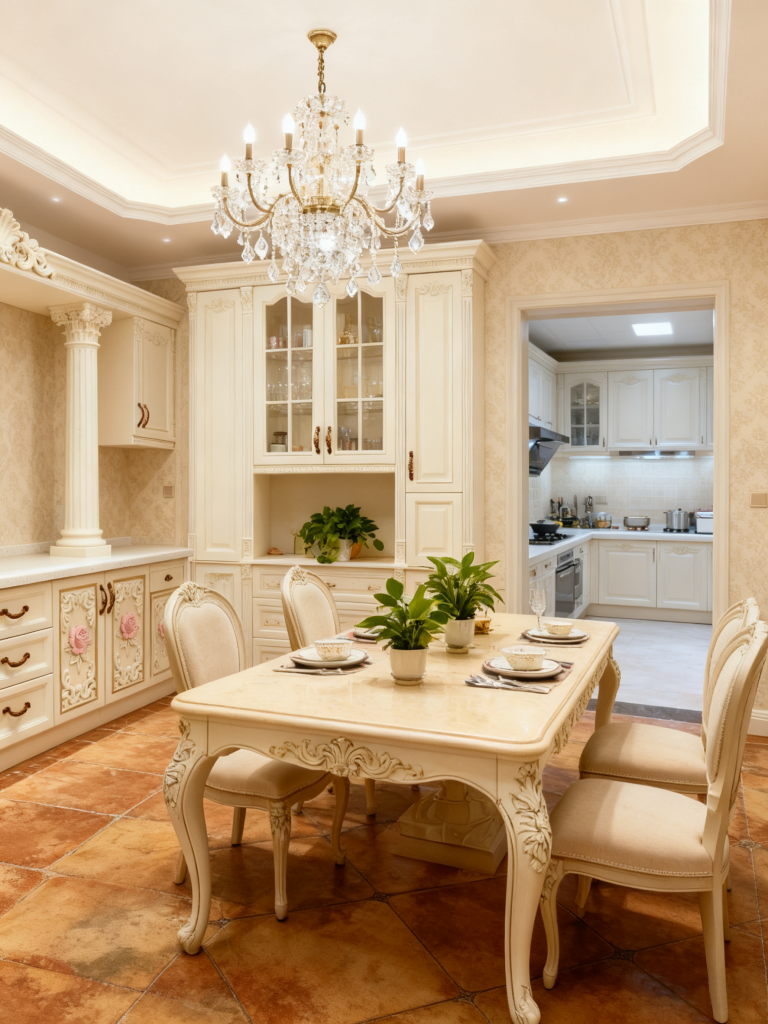
3. Interior Decoration and Architectural Woodwork
• Curved and 3D surfaces: Ideal for creating spiral staircases, decorative wall panels, ceiling elements, and custom moldings.
• Architectural details: Achieves perfect symmetry and surface smoothness for high-end interior projects.
• Artistic freedom: Enables designers to bring creative and organic architectural forms to life.
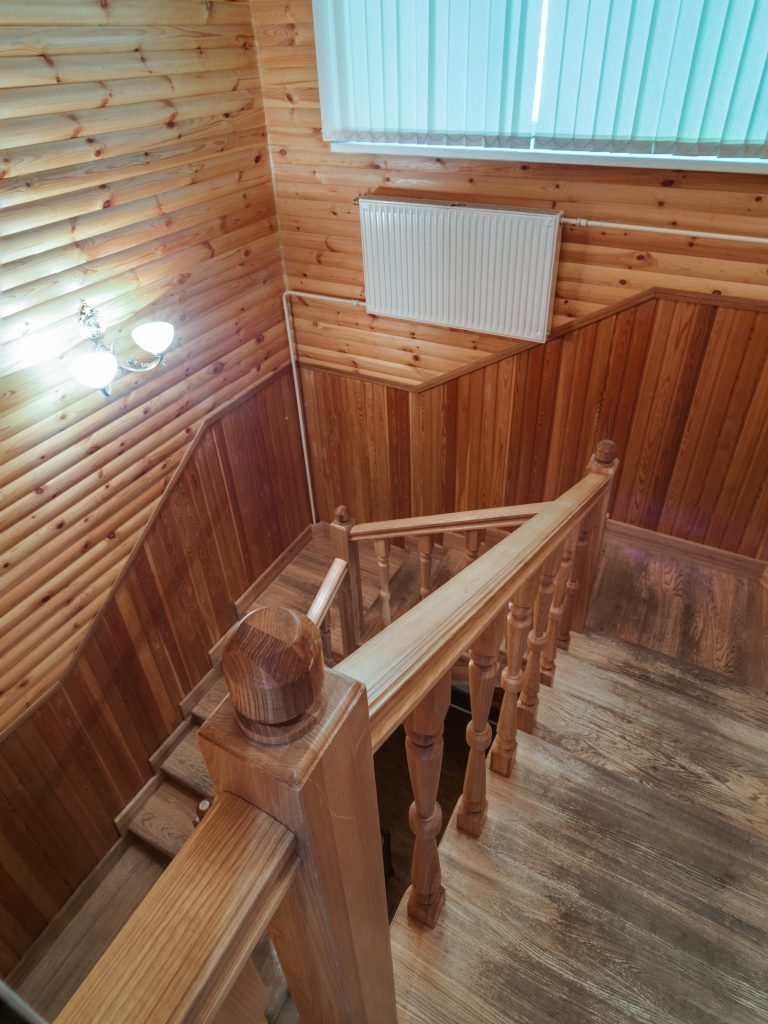
4. Wood Molding and Prototyping
• High-precision prototypes: Used to make accurate wooden molds, prototypes, or tooling for other manufacturing processes.
• Smooth surface finish: Reduces post-processing steps, ensuring ready-to-use components.
• Multi-material capability: Works efficiently on MDF, hardwood, or composite materials used in industrial prototyping.
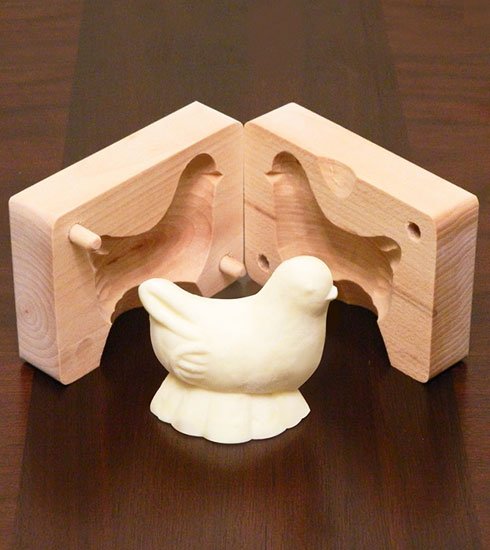
5. Artistic Carving and Craftwork
• Fine detailing: Enables production of intricate wood carvings, religious sculptures, reliefs, and artistic installations.
• Consistent results: Once the design is programmed, the machine can reproduce identical pieces for mass production.
• Expanded creativity: Artists and craftsmen can achieve levels of detail and symmetry not possible with manual tools.

IX.Troubleshooting Common 5 Axis Issues
Even with premium equipment, knowing basic troubleshooting can save time.
| Issue | Possible Cause | Blue Elephant Solution/Tip |
| Poor Surface Finish on Contours | Tool stick-out is too long; Feed rate is too fast; Non-optimal tool approach angle. | Use the shortest possible tool; Adjust your CAM programming to maintain a tangential approach; Reduce feed rates slightly for finishing passes. |
| Feature-to-Feature Inaccuracy | RTCP not properly calibrated or active; Part shifting due to weak clamping; Thermal expansion. | Verify RTCP engagement in the control system; Check and upgrade your fixturing; Allow for a 15-minute machine warm-up cycle. |
| Excessive Vibration/Chatter | Insufficient spindle power or rigidity for the cut; Tool is dull or unbalanced. | Check your cutting data (RPM/Feed Rate); Ensure the machine is properly bolted to a solid foundation; Invest in balanced tool holders. |
X. Mastering 5 Axis Router Maintenance for Longevity
To protect your investment and maintain sub-millimeter precision, adherence to a strict maintenance schedule is non-negotiable:
- Lubrication: Regularly grease or oil all linear guides, ball screws, and especially the rotary axis bearings and gearboxes. Use only the specified lubricants.
- Spindle Health: Monitor the spindle chiller or cooling system fluid level and temperature. High temps are the enemy of precision.
- Dust/Chip Management: Ensure your dust collection system is working optimally to keep fine particles away from delicate guides and sensors.
- Calibration Checks: Periodically verify the rotational axis zero points. Blue Elephant recommends a professional laser or ball-bar calibration check annually to correct any geometric drift.
- Control System Backup: Regularly back up your CNC control system parameters and tool offset data—this saves valuable time if a control issue occurs.
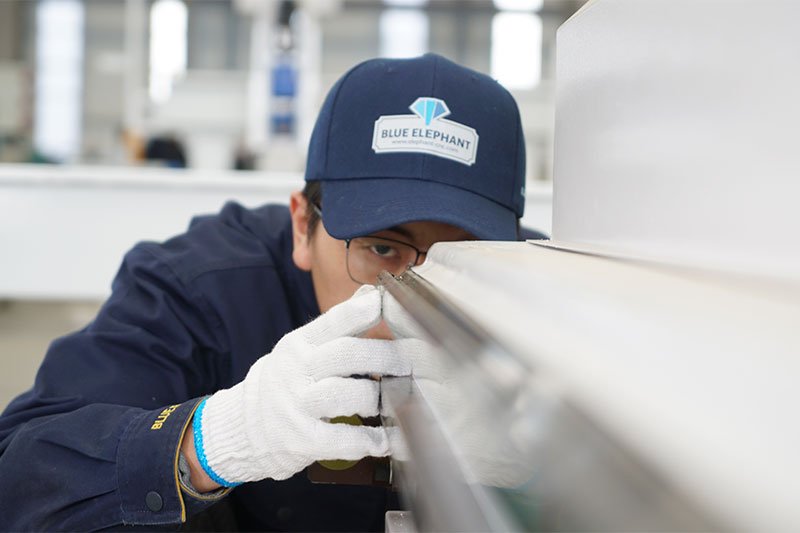
XI. How to Choose the Best 5 Axis CNC Router
As you evaluate your options, use this checklist to compare machines:
- Define Your Needs: What is the largest/smallest part you will machine? What are your required tolerances? Answer this first—it dictates the machine size and rigidity.
- Insist on Quality Components: Don’t settle for no-name parts. Demand proven, global brands for the Spindle, Servos, Controller, and ATC system. Blue Elephant is transparent about our premium component sourcing.
- Evaluate Machine Rigidity: Ask for the machine’s weight and frame material. A heavy, cast, or thick-walled welded steel base is a sign of good vibration dampening and long-term accuracy.
- Demand Comprehensive Support: 5-axis technology requires expertise. Ensure the supplier provides extensive on-site installation, training, and reliable post-sale technical support in your region.
- Check for True RTCP: Confirm that the machine features true simultaneous 5-axis control and RTCP function for the highest possible accuracy on contours.
XII. The Time to Upgrade Your Capacity is NOW!
You have the ambition, the designs, and the drive to produce superior products. All you need is the right tool to unlock that potential.
A Blue Elephant 5 Axis CNC Router is not just a purchase; it’s the strategic investment that will allow you to:
- Win higher-value contracts.
- Increase your production speed exponentially.
- Deliver quality and precision that surpasses your competition.
Stop settling for multiple setups and flawed finishes. Invest in precision. Invest in Blue Elephant.
Contact our expert team today for a detailed consultation and a customized quote tailored to your specific production goals!
Recommend reads: