
In the fast-evolving landscape of industrial manufacturing, precision and efficiency are paramount. Laser marking machines have emerged as indispensable tools for a myriad of applications, ranging from product identification to engraving and coding. As we step into 2024, it becomes crucial for businesses and manufacturers to stay abreast of the latest advancements in laser marking technology. This comprehensive buyer guide aims to provide a detailed overview of the key factors to consider when investing in a laser marking machine.
1. Understanding Laser Marking Technology
What is laser marking? Laser marking is a process in which a laser beam is used to create marks or patterns on a material’s surface. This technique is widely used for labeling, identification, tracking, and decoration purposes across various industries. Laser marking is known for its precision, permanence, and versatility. It can be applied to a wide range of materials, including metals, plastics, glass, ceramics, and more.
2. Types of Laser Marking Machine
- Fiber Laser Marking Machines: Utilize fiber lasers for marking a variety of materials, including metals, plastics, and some ceramics.
- CO2 Laser Marking Machines: Use carbon dioxide lasers and are suitable for marking non-metallic materials like wood, glass, leather, and certain plastics.
- UV Laser Marking Machines: Employ ultraviolet lasers and are ideal for high-contrast marking on sensitive materials, such as medical devices and electronic components.
- Green Laser Marking Machines: Use green lasers and are suitable for marking materials like copper, gold, and other reflective surfaces.
- YAG Laser Marking Machines: Use yttrium aluminum garnet (YAG) lasers and are often used for deep engraving on metals.
Comparison of Different Types of Laser Marking Machines
| Type of Laser Marking Machine | Laser Source | Best For | Suitable Materials | Advantages | Common Applications |
| Fiber Laser Marking Machine | Fiber laser | Metal marking and industrial applications | Stainless steel, aluminum, copper, brass, some plastics, ceramics | High speed, excellent precision, long service life, low maintenance | Automotive parts, electronics, hardware, tools, jewelry, product identification |
| CO2 Laser Marking Machine | Carbon dioxide laser | Non-metal material marking and engraving | Wood, acrylic, glass, leather, rubber, paper, some plastics | Large marking area, versatile, cost-effective, suitable for various non-metal materials | Wood products, packaging, crafts, signs, leather products |
| UV Laser Marking Machine | Ultraviolet laser | High-precision marking on sensitive materials | Plastics, glass, PCB, medical devices, electronic components | Ultra-fine marking, minimal heat damage, high contrast results | Electronics, medical products, precision components, cosmetic packaging |
| Green Laser Marking Machine | Green wavelength laser | Reflective and heat-sensitive material marking | Copper, gold, silver, silicon, some plastics | Better absorption on reflective materials, precise marking with less heat impact | Semiconductor components, electronics, jewelry, solar products |
| YAG Laser Marking Machine | Yttrium Aluminum Garnet laser | Deep engraving and durable metal marking | Steel, aluminum, precious metals | Strong engraving capability, reliable performance for permanent markings | Metal parts, molds, industrial components |
3. Pros and Cons of Laser Marking Machine
Pros of Laser Marking Machines
Understanding the laser marking machine benefits can help businesses make better purchasing decisions. laser marking machines provide a reliable solution for various industries and materials.
- Precision and Accuracy: Laser marking offers high precision and accuracy, allowing for intricate and detailed markings.
- Non-Contact Process: Laser marking is a non-contact process, meaning there is no physical contact between the marking device and the material. This reduces the risk of damage to the material being marked.
- Versatility: Laser marking machines can mark a wide range of materials, including metals, plastics, glass, ceramics, and more.
- Permanent Marking: Laser markings are generally permanent and resistant to wear, chemicals, and environmental factors.
- Speed: Laser marking can be a fast process, making it suitable for high-volume production environments.
- Automation Integration: Laser marking machines can be easily integrated into automated production lines, allowing for efficient and continuous marking.
- Reduced Consumables: Unlike some traditional marking methods, laser marking typically requires fewer consumables, resulting in cost savings over time.
- Computer-Controlled: Laser marking machines can be computer-controlled, providing flexibility and ease of use.
Cons of Laser Marking Machines
Although laser marking machines provide many advantages, they also have some limitations that should be considered before investment.
- Initial Cost: Laser marking machines can have a higher upfront cost compared to some traditional marking methods.
- Maintenance: While lasers are generally reliable, they do require regular maintenance to ensure optimal performance.
- Material Limitations: While laser marking is versatile, certain materials may not respond well to laser marking, or specific types of lasers may be required for optimal results.
- Energy Consumption: Depending on the laser type and power, laser marking machines can consume a significant amount of energy.
- Safety Concerns: Laser systems can pose safety hazards if not used properly. Operators should follow safety guidelines and use appropriate protective measures.
- Limited Depth on Some Materials: While suitable for surface marking, laser marking may not be the best choice for deep engraving on certain materials.
4. Differences between Laser Engraving Machines and Laser Marking Machines
4.1 Depth of Material Removal
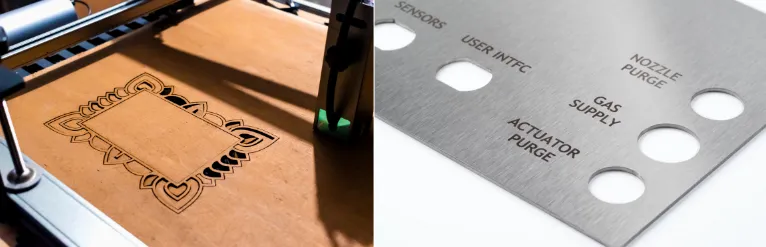
Laser Engraving: Engraving involves removing material from the surface, creating a visible indentation. Laser engraving machines are capable of deeper material removal, and they are often used for creating depth and texture in the engraved area.
Laser Marking: Marking, on the other hand, typically involves altering the surface properties without significant material removal. The process is usually more superficial, resulting in markings without noticeable depth.
4.2 Application and Purpose
Laser Engraving: Engraving is commonly used for artistic purposes, creating intricate designs, text, or patterns on materials. It is also used for creating serial numbers, logos, and other permanent markings with depth.
Laser Marking: Marking is often used for adding identifiers, barcodes, QR codes, or other information to products. The purpose is to provide a permanent, traceable mark on the surface without altering the material’s structure significantly.
4.3 Material Interaction
Laser Engraving: Engraving is suitable for a wide range of materials, including metals, wood, acrylic, and more. It involves removing material, and the appearance of the engraving can vary based on the material’s characteristics.
Laser Marking: Marking is versatile as well but is particularly effective on metals, plastics, ceramics, and other materials where a high-contrast mark is desired without significant material removal.
4.4 Speed and Efficiency
Laser Engraving: Engraving is often a slower process than marking because it involves deeper material removal. The speed depends on the complexity of the engraving and the desired depth.
Laser Marking: Marking is generally faster than engraving, making it suitable for high-speed production lines. The focus is on creating visible, surface-level marks efficiently.
4.5 Cost
Laser Engraving: Engraving machines may have a higher upfront cost due to their capabilities for deeper material removal and often more sophisticated machinery.
Laser Marking: Marking machines can be more cost-effective for certain applications, especially when depth is not a critical factor.
In summary, laser engraving involves deeper material removal for artistic or functional purposes, while laser marking focuses on creating visible surface-level marks for identification and traceability. The choice between the two depends on the specific requirements of the application.
5. Price of Laser Marking Machine
How much does a laser marking machine cost? The cost of laser marking machines can vary significantly based on several factors, including the type of laser, power, features, brand, and the specific application requirements. Here’s a general overview of the price ranges for different types of laser marking machines.
Fiber Laser Marking Machines
Entry-level desktop models: $5,000 – $15,000
Mid-range industrial models: $15,000 – $50,000
High-end industrial and custom solutions: $50,000 and above
CO2 Laser Marking Machines
Entry-level desktop models: $4,000 – $12,000
Mid-range industrial models: $12,000 – $30,000
High-end industrial and custom solutions: $30,000 and above
UV Laser Marking Machines
Entry-level desktop models: $8,000 – $20,000
Mid-range industrial models: $20,000 – $50,000
High-end industrial and custom solutions: $50,000 and above
Green Laser Marking Machines
Entry-level desktop models: $8,000 – $18,000
Mid-range industrial models: $18,000 – $40,000
High-end industrial and custom solutions: $40,000 and above
It’s important to note that these are approximate price ranges, and the actual cost can vary based on additional factors such as the laser power (wattage), marking area size, automation features, and the reputation of the laser marking machine manufacturer. Customized or specialized solutions with unique features may also be priced higher.
Additionally, the market evolves, and new models or technologies may impact pricing over time. It’s recommended to obtain quotes from different suppliers, considering your specific needs and requirements, to get a more accurate estimate for the laser marking machine that suits your application.
6. How to Choose the Right Laser Marking Machine
Selecting the right laser marking machine is crucial for your production operations. Beyond understanding the different types of machines, you must evaluate specific models based on key factors such as material compatibility, laser power, working area, software and control systems, and after-sales service.
- Material Compatibility: Fiber laser marking machines are the best choice for metal processing; CO2 laser marking machines are suitable for organic materials like wood, glass, and leather; and UV laser marking machines are used for marking sensitive components.
- Laser Power: Laser power affects marking speed, marking depth, and processing efficiency. A 20W laser is suitable for light-duty marking tasks such as QR codes and product serial numbers; 30W is appropriate for most standard industrial marking applications; deep engraving and processing of hard metals require higher power, such as 50W; and lasers with 60W or higher power are ideal for deep engraving and high-efficiency industrial processing.
- Working Area: Choose a smaller marking area for items like jewelry, small parts, and electronic components, whereas larger products require a machine with a larger marking area.
- Software and Control Systems: Common laser marking software includes LightBurn, AutoCAD, and CorelDRAW. Especially for new users, selecting software that is easy to use and offers good compatibility can reduce the learning curve.
- After-Sales Service: A reliable supplier should provide comprehensive technical support, training, and warranty services. Robust service helps minimize downtime and reduce potential losses.
7. 5 Typical Mistakes to Avoid When Buying a Laser Marking Machine
When purchasing a laser marking machine, actual production needs are often overlooked in favor of the price tag. Here are five common pitfalls to avoid during the buying process:
- Focusing solely on power while ignoring beam quality: Marking precision depends on beam quality; a system with lower power but superior beam quality often delivers better marking results.
- Focusing only on specifications without testing actual marking performance: The same machine may yield different results on different materials. Therefore, it is essential to have the supplier perform sample tests before purchasing.
- Overlooking software compatibility and ease of use: Some buyers fail to consider software complexity or support for common design file formats, leading to a steep learning curve for staff. Confirming software usability beforehand is crucial, as user-friendly software allows for a faster transition to production.
- Ignoring long-term operating costs: Purchase decisions should not be based solely on the machine’s initial price; factors such as maintenance, spare parts replacement, and losses due to downtime must also be considered. A low cost laser marking machine may lack stability, resulting in higher long-term operating costs compared to a more expensive, reliable model.
- Neglecting environmental ventilation: Laser marking generates fumes and dust, so it is vital to install an appropriate exhaust system in strict accordance with requirements.
FAQ
1. What should I consider when buying a 30W fiber laser marking machine?
The 30W laser marking machine strikes an excellent balance between processing capability and equipment cost. It offers significantly higher processing efficiency and depth compared to 20W models, while maintaining a distinct price advantage over 50W and 100W laser marking machines.
However, when purchasing, it is crucial to consider factors such as the laser source type (Q-Switched vs. MOPA), lens size and working area, software compatibility, structural design and safety features, as well as optional accessories like rotary axes and fume extraction systems.
2. What are the latest advancements in laser marking technology?
Laser marking technology is currently evolving toward high levels of intelligence, adaptability, and sustainability.
In terms of intelligence, laser marking has achieved capabilities such as adaptive parameter setting, automatic color marking, and intelligent vision integration for the real-time adjustment of marking angles and focal lengths.
Furthermore, there is no longer a need to purchase multiple laser systems with different light sources, as laser marking equipment now supports dual-beam configurations. Multi-axis dynamic control systems ensure uniform and consistent marking results on curved surfaces.
“Cold marking” technology enables microscopic, ultra-high-precision marking on advanced semiconductors and medical catheters.
Laser marking technology replaces traditional chemical-intensive processes, meeting the demands of modern sustainable development.
3. Can laser marking be used on various materials and surfaces?
Yes. Laser marking can be applied to a wide range of materials, including metals, plastics, organic materials (such as wood and leather), glass, ceramics, stone, rubber, silicon, composites, and semiconductors. It is suitable for various surface types and shapes—including flat and curved surfaces; painted, coated, or anodized finishes; textured or polished materials; and cylindrical objects.
4. How does laser marking work in industrial manufacturing?
In the industrial sector, laser marking is primarily utilized for processes such as laser annealing, engraving, etching, coloring, and carbonization. It is widely adopted due to its ability to produce permanent, indelible marks without the need for consumables; the non-contact nature of the process eliminates tool wear, while also enabling high-speed, high-precision production.
5. Can I use laser marking for different types of PCB materials?
Yes. Laser marking is ideally suited for printed circuit boards made from a variety of materials, such as metal, plastic, and ceramic.
Conclusion
In this blog, we delved into the working principles, various types, widespread applications, and pricing ranges of laser marking machines. The emergence of laser marking technology has not only revolutionized industrial production by significantly improving efficiency and precision but has also found unique applications in fields such as medicine, art, and jewelry.
As technology continues to advance, laser marking machines have achieved remarkable success in enhancing productivity and accuracy, offering ample space for innovation. From small enterprises to large-scale manufacturing, laser marking technology demonstrates its robust applicability and flexibility.
When selecting a laser marking machine, understanding the characteristics of different types and their suitability for specific industries and materials is crucial to ensuring the accuracy and effectiveness of the investment. While price is a consideration, it is more important to choose a model based on project requirements and expected outcomes.
In summary, the continuous development of laser marking technology promises more possibilities across various industries, propelling transformations in innovation and production methods. Looking ahead, we have reason to anticipate the outstanding application value of laser marking technology in more fields. We hope this blog provides you with a solid foundation of knowledge about laser marking machines and serves as a helpful reference in your decision-making process.
Check out more related articles here: