
Choosing between laser cleaning and dry ice blasting depends on your part precision and running costs. Dry ice blasts heavy coatings but requires continuous pellet purchases. Laser cleaning demands zero consumables and delivers micron-level accuracy. Here is the direct financial and technical comparison for your factory.
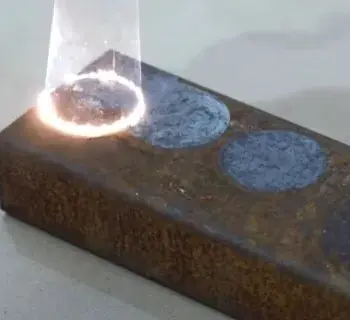
Industrial Fiber Laser Cleaning Machine
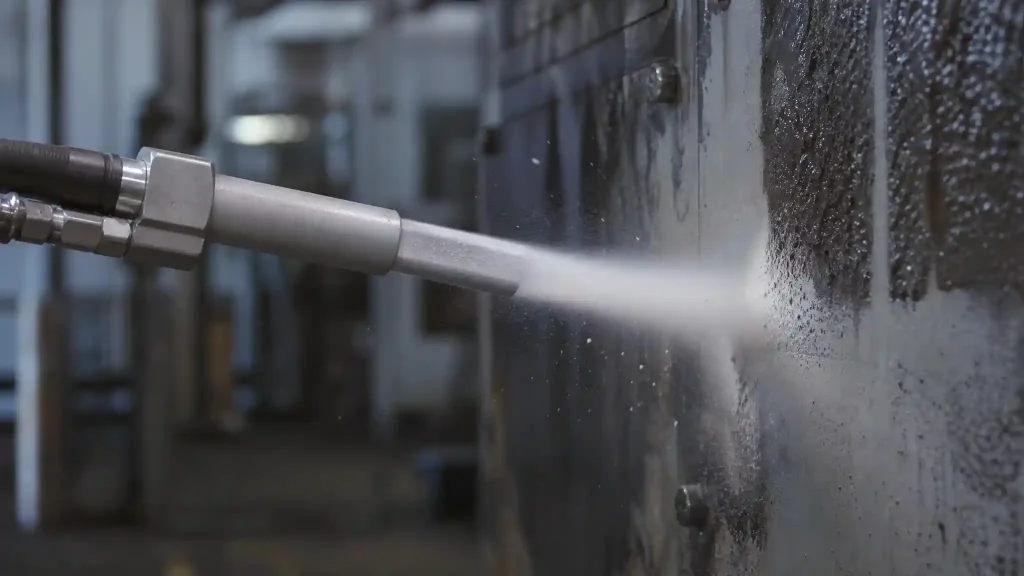
Dry Ice Blasting Nozzle Operation
1. Quick Comparison
Laser vs. Dry Ice: Key Cost and Performance Factors
| Comparison Factor | Laser Cleaning | Dry Ice Blasting |
| Initial CAPEX | High investment | Low to medium investment |
| OPEX per Hour | Low cost from one to two dollars for electricity | High cost from twenty to fifty dollars for pellets and air |
| Consumables | No direct consumable materials required | Dry ice pellets with high daily sublimation loss |
| Substrate Impact | No mechanical wear under proper operating parameters | Potential micro-abrasion on soft metals |
| Noise Level | Low noise under seventy-five decibels | Extreme noise over one hundred decibels |
| Secondary Waste | None because HEPA extractor captures dust | None because pellets disappear into gas |
| Supply Chain Dependency | No pellet supply dependency | High dependency because pellets melt in storage |
| ATEX Compliance | Poor due to high custom isolation costs | Excellent due to natural spark-free operation |
| Surface Precision | High accuracy down to one hundred microns | Standard accuracy with risk of pellet blast impact |
| Best Application | Precision injection molds and automated lines | Thick sticky grease and hazardous explosive zones |
Laser cleaning delivers micron-level accuracy and eliminates continuous consumable costs. Only choose dry ice blasting for thick bitumen or hazardous ATEX explosion-proof zones.
2. Cleaning Principles
2.1 Choosing Your Industrial Cleaning Technology
Selecting the right industrial cleaning technology requires a clear understanding of how each method interacts with the substrate surface. Here is a direct comparison of the core mechanisms behind laser cleaning and dry ice blasting.
2.2 Laser Cleaning: Non-Contact Precision Cleaning
Laser cleaning removes surface contamination through photoablation. A pulsed 1064nm laser beam targets the contamination layer directly. Rust, paint, and oxide on your parts absorb the laser energy much faster than the base metal.
The absorbed energy turns into heat within a very short time. The contamination layer breaks apart and turns into vapor or fine particles.
The metal surface reflects most of the laser energy. This prevents heat buildup in the base material. There is no physical contact during cleaning, so no mechanical stress is applied.
This process is suitable for precision work such as rust removal, mold cleaning, and weld preparation, where surface protection is critical.

Laser Cleaning Selective Absorption Mechanism
2.3 Dry Ice Blasting: Impact, Thermal Shock & Expansion
Dry ice blasting removes your surface contamination through a combination of impact, thermal shock, and sublimation. First, high-pressure air accelerates solid CO₂ pellets toward the surface. The pellets hit and break the loose contamination layer through physical impact.
Second, the surface temperature drops quickly to −78.5°C. This rapid cooling makes rust, grease, and coatings brittle. The bond between the contamination and the metal weakens and becomes easier to remove.
Third, dry ice turns directly from solid into gas. The volume expands by about 800 times. This expansion helps lift and remove the loosened material from the surface. No liquid residue remains after cleaning because the pellets fully sublimate into carbon dioxide gas.
This method works well for large-area cleaning and soft contaminants such as grease, oil residue, rubber, and light coatings. It is less effective on tightly bonded rust or thick oxide layers. Soft materials may show slight surface wear after repeated impact.
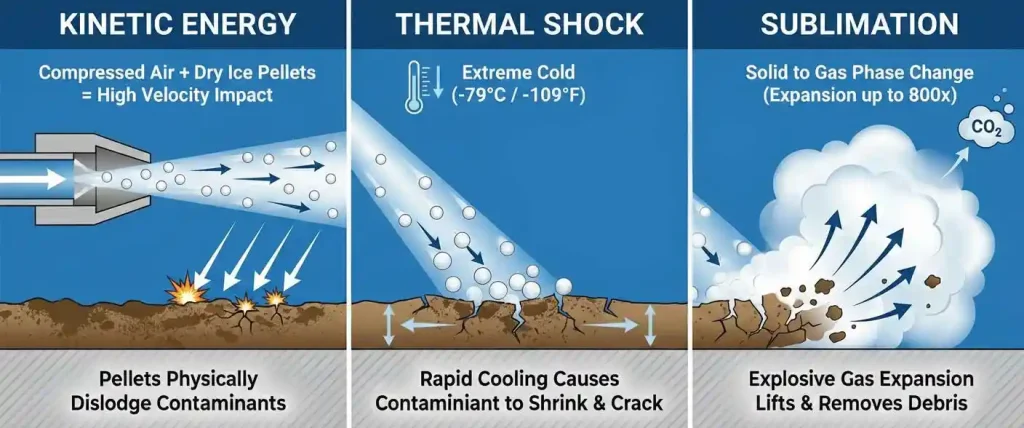
How Dry Ice Cleaning Works Diagram
3. Financial Return
3.1 Laser: Fast 12-Month Return
Investing in fiber technology ensures a rapid laser cleaning machine ROI through massive operational savings.
- Zero consumable costs: Laser machines run purely on electricity, costing only $2 per day. This slashes your annual operating budget to nearly zero, allowing most factories to fully recover the machine cost within 10 to 12 months.
- In-press maintenance gains: Operators clean molds directly inside the hot molding machinery. This In-Press Cleaning eliminates the teardown stage completely.
- Maximum production throughput: Laser technology reduces maintenance shutdown times from six hours to just one hour. This direct efficiency boost maximizes your weekly factory output.
3.2 Dry Ice: High Ongoing Expenses
A detailed dry ice blasting cost comparison reveals a serious long-term budget trap.
- High consumable waste: Natural sublimation destroys 10% to 20% of stored dry ice pellets daily. Dry ice supply is unstable, and delivery delays will stop your production line.
- Hidden power costs: Dry ice machines require a massive, heavy-duty industrial air compressor. This auxiliary equipment heavily inflates monthly electricity bills.
- Expensive outsourcing fees: Hiring external cleaning services causes high service premiums. Waiting for outside technicians leads to unplanned downtime losses and cuts your production profits.
4. Application Fit and Limits
| Application | Pros and Limits | Winning Technology | |
| Laser Cleaning | Dry Ice Blasting | ||
| Precision Micro-Molds | Pros: Zero wear on textures. Limits: Reflective mirror finishes reduce efficiency. |
Pros: Safe for standard molds. Limits: Leaves moisture; risks pellet impact wear. |
Laser wins for micro-cavities and strict tolerance preservation. |
| Heavy Structural Steel | Pros: Removes heavy rust easily. Limits: Line-of-sight only; cannot clean pipe blind spots. |
Pros: Good for large areas. Limits: Fails completely on tight, heavy rust layers. |
Laser wins for breaking tight inorganic rust bonds. |
| Thick Bitumen and Tar | Limits: Slow speeds; struggles with viscous coatings >3mm. | Pros: Rapid thermal cracking; lifts thick layers easily. | Dry ice wins for thick, sticky organic waste. |
| Delicate Historic Stone | Pros: Non-contact soot/carbon removal. | Limits: High blast pressure causes erosion risks. | Laser wins for safe, intricate detail preservation. |
When choosing a cleaning method, you also need to know:
For laser cleaning, highly reflective mirror finishes lower efficiency and risk damaging the optical lens. Rapid heat can scorch wood, crack glass, or melt low-tolerance plastics.
For dry ice blasting, high-velocity pellet impacts cause micro-abrasion over time, risking distortion to the strict tolerances of soft copper or aluminum parts.

Precision Injection Tire Mold Laser Cleaning
5. Compliance Risks and Safety
5.1 Environmental Compliance
- Noise control: Laser cleaning operates at under 75 dB, making the shop floor more comfortable. Dry ice blasting operations consistently exceed 100 dB. This creates high risks for operator hearing damage and costly OSHA penalties.
- Air pollution: The chemical-free laser process leaves zero airborne secondary waste. A connected HEPA fume extractor traps all vaporized dust at the source to help you pass emission tests.
5.2 Operator Safety
- ATEX explosive zones: Upgrading a laser system for these zones is complex and expensive. Dry ice blasting is much safer. The pneumatic nozzle requires no electricity and creates zero electrical sparks.
- Cold burn: Shifting to laser cleaning eliminates the risks of cold. Dry ice pellets sit at a freezing −78.5°C. Any mistake during handling can cause severe cold burns.
- Breathing and eye safety: Laser technology uses zero gas, so your workers face no suffocation risks. Operators only need standard safety glasses to protect their eyes. Using dry ice in closed areas creates dangerous carbon dioxide buildup, which can easily suffocate workers.

Laser Cleaning Operator Safety Gear
6. Distributor Market Analysis
The mature dry ice segment has reached saturation. This creates severe price competition and low profit margins for local importers. Market demand is shifting toward advanced laser cleaning solutions.
Laser technology operates as a high-ticket segment with better profit margins. Offering this system helps regional distributors secure accounts with Tier-1 manufacturers and high-end industrial clients.
If you want to get the latest industrial laser cleaning machine price or explore wholesale laser cleaning machine partnership opportunities in your local market, contact our team today.
7. FAQ
Q1: Which Is Better for Mold Cleaning: Laser Cleaning Machine or Dry Ice Blasting System?
For injection mold cleaning and precision mold maintenance, laser cleaning is preferred. It provides high accuracy and no consumable cost. Dry ice blasting is more suitable for removing soft contaminants such as grease or residue, but may introduce moisture and requires a continuous pellet supply.
For factories focusing on high-value mold production and reduced downtime, laser cleaning is better.
Q2: Is Laser Cleaning Safe for Metal Rust Removal Without Damaging the Base Material?
Laser cleaning is used for rust removal on steel, stainless steel, and mold surfaces.
It is a non-contact process that removes oxide layers without touching the base material.
When you properly adjust settings such as power and scanning speed are properly adjusted, the base metal keeps its surface condition.
Q3: Laser Cleaning vs. Dry Ice Blasting Cost per Hour: Which Is More Cost-Effective for Industrial Use?
Laser cleaning costs about $1–$2 per hour, based mainly on electricity consumption. Dry ice blasting cost per hour is $20–$50, due to dry ice pellet consumption and supply chain logistics. In the long run, laser cleaning is cheaper.
Q4: How Does Laser Cleaning vs. Dry Ice Blasting Speed Compare in Industrial Mold Cleaning Efficiency?
Laser cleaning is faster for spot cleaning and precision mold maintenance. It avoids teardown and allows in-place cleaning.
Dry ice blasting is faster for large-area surface cleaning, typically 2–4 times higher coverage speed due to wide spray impact.
Q5: What Are the Electrical Power Requirements for a Pulse Laser Cleaning Machine, and Do Factories Need Power Grid Upgrades?
200W–300W laser cleaning systems operate on 2–3 kW power input and use 220V single-phase power.
1000W–2000W systems require 6–12 kW power input and run on 380V three-phase industrial power.
Lower power systems can be integrated into your standard factory setups. Higher power systems may require three-phase power availability depending on facility configuration.
Q6: What Should I Do If My Application Hits The Limits of Both Laser and Dry Ice?
These two technologies are often complementary—dry ice excels at stripping the thick grease that slows down lasers, while pulsed lasers vaporize the heavy rust that dry ice cannot break.
For extreme scenarios like deep, complex pipe blind spots, you should consider fluid-based third alternatives. Like high-pressure water jetting or Clean-in-Place (CIP) circulation. They ensure a 360-degree clean without thermal or mechanical risks.
8. Final Thoughts
Laser cleaning offers lower operating costs and higher precision. Dry ice suits bulk cleaning tasks. Choose the technology that best suits your specific application. Blue Elephant CNC provides suitable laser cleaning machines. Contact us to get more details.
Read more in our related blogs:
- Top 10 Laser Cleaning Machines in Canada 2026
- Top 10 Laser Cleaning Machines in the UK
- 8 Best Laser Cleaning Machines
- How to Make Money with A Laser Cleaning Machine?
- How to Choose a Laser Cleaning Machine for Beginners?
- What Can A 100W Laser Cleaning Machine Do?
- 8 Factors Affecting Laser Cleaning Machine Price