
Years ago, I was working on a tight deadline. A client needed custom parts, and I had to machine them fast. I grabbed the metal stock, set up the lathe, and got to work.
But as I cut, I realized something was off. The shape wasn’t right. The part needed flat surfaces—a job for a milling machine, not a lathe. That mix-up almost cost me the project.
If you’re wondering whether to use a milling machine or a lathe, I understand. They both remove material, but in different ways. I’ve spent years working with both, and I’ve seen firsthand how choosing the wrong one can waste time and money.
In this article, we’ll go over the key differences between these machines, what they’re best for, and how to decide which one to use.
By the end, you’ll know exactly which tool fits your job.
Let’s get started!
Milling Machine vs Lathe: Quick Comparison Table
| Feature | Milling Machine | Lathe |
| Cutting Motion | Rotating cutter | Rotating workpiece |
| Best For | Flat & complex parts | Cylindrical parts |
| Accuracy | High | Very High |
| Speed | Medium | Fast |
| Setup Time | Longer | Short |
| Automation | Excellent | Excellent |
| Material | Metal/Wood/Plastic | Mainly round stock |
| Cost | Higher | Lower |
| Maintenance | Moderate | Low |
| Learning Curve | Harder | Easier |
| Tool Movement | Multi-axis | X/Z Axis |
| Surface Finish | Excellent | Excellent on round parts |
| Production Volume | Prototype & mixed production | Mass production |
| Common Industries | Aerospace, Mold | Automotive, Shaft |
| ROI | High versatility | High efficiency |
1. Primary Function of Milling and Lathe Machine
I still remember my early days in the shop when my supervisor gave me a simple challenge: “Make a perfect cylinder and a flat plate.” Easy, right? Not so much. I used the lathe for the plate and the milling machine for the cylinder—completely backward. That mistake cost me hours, but it taught me a lesson I never forgot.
If you’ve ever stood in front of a milling machine or lathe wondering which one to use, you’re not alone. Both remove material, but they do it in completely different ways. Let’s break it down so you never have to second-guess your choice.
Understanding the Core Operations of Milling and Lathe Machines
At their core, both machines are designed for precision manufacturing, but they function differently:
- Lathes Focus on Rotation: The workpiece spins while a stationary cutting tool removes material. This is best for making round or cylindrical parts.
- Milling Machines Focus on Movement: The workpiece stays still while a rotating cutting tool moves across it. This is ideal for flat surfaces, slots, and complex shapes.
Both machines are essential in metalworking, but knowing their strengths will save you time, material, and frustration.
How a Lathe Works
A lathe works by rotating the workpiece at high speed while a cutting tool shaves off layers. Imagine a woodworker turning a spinning log into a baseball bat—except with metal, and much more precise.
Key Functions of a Lathe:
- Turning: Creates cylindrical shapes by removing material as the workpiece spins.
- Facing: Flattens the end of a workpiece.
- Drilling: Uses a drill bit to make holes in the center of a spinning part.
- Thread Cutting: Forms screw threads with extreme precision.
- Knurling: Adds textured patterns for grip, often seen on hand tools.

How a Milling Machine Works
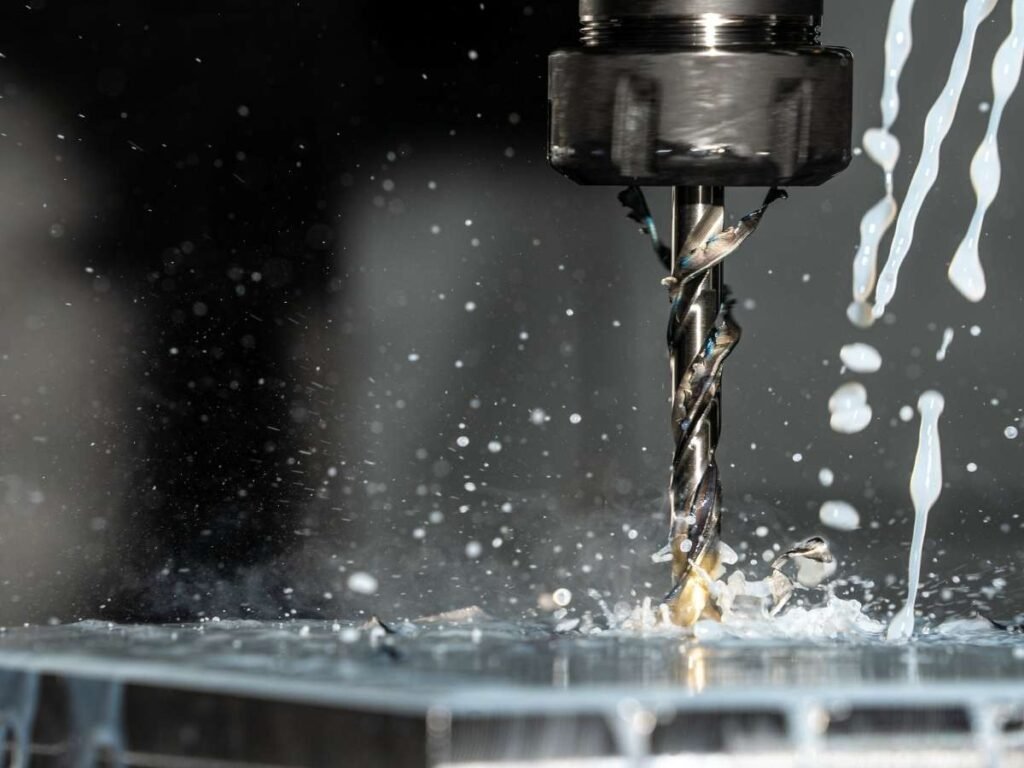
Unlike a lathe, a milling machine holds the workpiece still while a rotating cutting tool moves across it. This setup allows you to cut precise slots, drill off-center holes, and shape complex surfaces.
Key Functions of a Milling Machine:
- Face Milling: Creates flat, smooth surfaces.
- Slotting: Cuts grooves and keyways.
- Drilling and Boring: Produces deep, accurate holes.
- Contour Milling: Follows curves and irregular shapes for custom designs.
- Thread Milling: Forms screw threads without requiring a lathe.
If your part requires multiple features—like, like slots, holes, or curved surfaces—a, the milling machine is the right machine. At Blue Elephant, we are a professional CNC milling machine manufacturer and offer milling machines that use high-rigidity structures and industrial-grade components.
2. Cutting Motion & Orientation Differences
The first time I watched a lathe and a milling machine side by side, I thought, “They both cut metal. How different can they be?” Turns out, very different. One spins the workpiece, the other moves the tool. One shape, the other carves. Understanding their movement and orientation is key to choosing the right one for the job.
Axes of Movement: How Milling and Lathe Machines Differ
A machine’s axis of movement determines how the cutting tool interacts with the workpiece. If you’ve ever struggled with getting the right cut, chances are you weren’t thinking about movement in the right way.
- Lathes Use Two Axes: A lathe primarily moves along two axes—longitudinal (Z-axis) and cross (X-axis). The cutting tool moves in and out or side to side, while the workpiece spins.
- Milling Machines Use Three or More Axes: Milling machines typically move along three main axes—X (side to side), Y (front to back), and Z (up and down). More advanced machines add rotational axes for greater flexibility.
One of my first mistakes was trying to cut a square feature on a lathe. I figured, “Metal is metal, right?” Wrong. Without a milling machine’s multiple-axis movement, getting a clean, precise cut was nearly impossible.
3. Capabilities Comparison
If you’re choosing between a lathe and a milling machine, speed, accuracy, and automation will determine your efficiency. Let’s break down how each machine performs in these areas.
Speed: Which Machine Gets the Job Done Faster?
When time is money, you need to know which machine can complete your job faster. But speed isn’t just about cutting time—it includes setup, tool changes, and material handling.
Lathe Speed
Lathes are typically faster when working with cylindrical parts. The workpiece rotates at high speeds—often exceeding 3,000 RPM—while the cutting tool remains stationary. Because of this setup, turning, facing, and threading operations can be completed with minimal tool movement, leading to shorter cycle times and faster throughput.
Milling Machine Speed
Milling machines, by contrast, tend to be slower for simpler tasks. They require multiple passes to produce complex shapes, especially when working with intricate geometries or flat surfaces. Their cutting speeds depend on the type of tool and material in use but are generally lower than those seen in lathes. Additionally, milling often involves repositioning the workpiece between steps, which can slow down production and increase labor time.
Which One Wins on Speed?
- If you need fast, continuous cutting on round parts, a lathe is the better choice.
- If your part has multiple features and requires tool changes, a milling machine may take longer but provides more versatility.
Accuracy: Which Machine Delivers Tighter Tolerances?
Precision is everything in machining. A small miscalculation can mean a part that doesn’t fit, doesn’t function, or gets rejected altogether.
Lathe Accuracy
Lathes are known for delivering high consistency when machining round parts. Because the workpiece spins while the cutting tool remains stationary, there’s less manual handling involved. This setup helps lathes maintain tight tolerances, sometimes as precise as ±0.0001 inches, depending on the machine and overall setup. Their design makes them especially efficient for producing identical parts repeatedly with minimal error.
Milling Machine Accuracy
Milling machines, on the other hand, offer greater control over flat surfaces and complex shapes. While they can achieve tolerances of ±0.0005 inches or better, this often depends on proper calibration and skilled operation. Since milling involves more moving components and tool changes, there’s a slightly higher chance of deviation, especially over longer runs or intricate jobs.
Which One Wins on Accuracy?
- If you need perfectly round parts with high consistency, a lathe is the best choice.
- If your project requires flat surfaces, pockets, or intricate details, a milling machine provides more flexibility.
Automation: Which Machine Handles Repetitive Work Better?
Automation is a game-changer in modern machining. Whether you’re running one part or thousands, reducing manual work saves time and money.
Lathe Automation
CNC lathes are particularly strong in repetitive production. With bar feeders and minimal tool changes required, they can turn out large batches of identical parts with very little operator input. Once programmed, they can maintain accuracy over long cycles without constant adjustments.
I remember setting up a CNC lathe for a production run. Once programmed, it turned out identical parts without needing constant adjustments. That level of automation made it the clear winner for high-volume jobs.
Milling Machine Automation
CNC milling machines also support automation, especially in operations requiring multiple tool paths. With automatic tool changers, these machines can switch between tools in a single setup without pausing production. This makes them highly effective for complex part production where several operations need to happen in sequence. However, they do require more initial setup time and careful programming to prevent errors.
Which One Wins on Automation?
- If you’re machining high volumes of the same part, CNC lathes are faster and more efficient.
- If your project requires multiple operations in a single setup, CNC milling machines provide more flexibility.
4. Productivity and Workflow Comparison
When choosing between a milling machine and a lathe, you should consider not only their machining accuracy and capacity, but more importantly, which equipment can improve production efficiency and reduce unit costs.
The machining processes and production efficiencies of milling machines and lathes differ significantly. Understanding these differences can help you choose the most suitable equipment based on your production characteristics and mode.
CNC Lathe Machining Process and Efficiency
The main machining process of a lathe is as follows: loading round bar material, chuck clamping, end face machining, external turning, grooving/drilling, threading, cutting off, quality inspection, and obtaining the finished product. Lathes can complete the production of standardized parts in a short time and maintain stable machining accuracy. Due to the fixed machining process, they are very suitable for continuous production and mass production.
Milling Machine Machining Process and Efficiency
The machining process of a milling machine is more complex. It first requires design and programming with CAD/CAM software, and then actual machining. After a series of machining steps, including workpiece clamping and positioning, tool selection and tool setting, roughing, automatic tool changer (ATC), finishing, and quality inspection, the final product is obtained.
Although the production cycle for a single part is relatively long, milling machines can complete different processing steps in a single clamping. For companies that need to frequently change products to process complex parts, this processing flexibility is more important than processing speed.
5. Material Compatibility Differences
Not all materials cut the same way. Some require high speeds, others need slow, precise passes. The right choice depends on hardness, machinability, and tool wear resistance.
Best Materials for Lathes
Lathes excel at shaping cylindrical workpieces, so they work best with materials that cut cleanly while spinning.
- Metals:
- Aluminum: Soft, easy to machine, great for high-speed turning.
- Brass: Excellent for precise, fine cuts without much tool wear.
- Mild Steel: Commonly used but requires proper speeds to avoid tool wear.
- Stainless Steel: More challenging but machinable with carbide tooling.
- Titanium: Requires sharp tools and slower speeds due to toughness.
- Plastics:
- Nylon: Turns easily but can melt if speeds are too high.
- Delrin (Acetal): Smooth cutting with minimal chipping.
- Acrylic: Can be brittle, requiring sharp tools and slower feeds.
I once machined a brass connector on a lathe, and the ease of cutting was night and day compared to stainless steel. If you need smooth, precise round parts, lathes work best with soft to medium-hard materials.
Best Materials for Milling Machines
Milling machines remove material in multiple directions, making them ideal for materials that need precise shaping, drilling, and slotting.
- Metals:
- Aluminum: Cuts easily and allows for fast feed rates.
- Steel (Mild & Stainless): Machinable but requires controlled speeds.
- Copper & Brass: Soft, but can gum up tools if not cut properly.
- Titanium & Inconel: Tough, requiring carbide tooling and slow feeds.
- Plastics & Composites:
- HDPE (High-Density Polyethylene): Easy to cut, lightweight.
- Carbon Fiber: Requires special tooling to prevent fraying.
- Fiberglass: Abrasive to tools but used in aerospace applications.

6. Applications & Best Use Cases
If you’re still unsure whether to invest in a lathe or a milling machine, consider your machining application to choose the appropriate machine.
Lathe Applications: Lathes are specifically designed for producing rotationally symmetric parts, offering excellent concentricity and surface finish. They are commonly used to produce shafts, bushings, bearings, bolts, screws, pipes, rollers, and cycloid sleeves.
Milling Machine Applications: Milling machines excel at milling complex geometries from multiple angles. They are typically used to machine flat surfaces, slots and keyways, pockets and cavities, molds and dies, complex 3D components, gears, machine housings, and brackets.
Industry Comparison
| Industry | Milling Machine | Lathe |
| Automotive | Engine blocks, molds | Shafts, brake discs |
| Aerospace | Aircraft brackets | Landing gear shafts |
| Furniture | Fixtures, molds | Furniture legs |
| Medical | Implants | Surgical rods |
| Oil & Gas | Valve bodies | Pipes & couplings |
7. Maintenance & Durability Differences
If you’ve ever dealt with machine failures, you know how important maintenance and durability are. The right care keeps your lathe or milling machine running smoothly, while neglect can lead to costly repairs. Let’s look at how maintenance and durability compare between these two machines.
Routine Maintenance: What’s Required for Each Machine?
Keeping a machine in top shape isn’t just about preventing breakdowns—it’s about maximizing precision and efficiency over time.
| Maintenance Task | Lathe | Milling Machine |
| Daily Maintenance | – Clean chips and debris from the bed and slides. – Check tool sharpness to prevent excessive wear. – Apply lubrication to the ways (the tracks that guide the carriage). |
– Remove metal chips and clean the table surface. – Inspect coolant levels and flush old coolant if contaminated. – Grease moving parts to prevent excessive wear. |
| Weekly Maintenance | – Inspect belts and pulleys for wear. – Check and adjust spindle alignment. |
– Check tool holders and spindle runout (wobbling in the spindle). – Tighten loose bolts and fixtures to prevent misalignment. |
| Long-Term Maintenance | – Replace worn-out bearings and lead screws. – Inspect and replace coolant or cutting fluids as needed. |
– Inspect ball screws and ways for signs of wear. – Replace cutting fluids and recalibrate digital readouts. |
I once ignored a slight vibration in a lathe spindle, thinking it was minor. A few weeks later, it turned into a serious alignment issue that affected every part I machined. A simple weekly check could have prevented a costly repair.
Similarly, I saw a milling machine that hadn’t been cleaned in weeks. The table was coated in dried coolant and metal chips, and the slides were starting to jam. The operator had to stop work and spend hours doing preventive maintenance that should have been done daily.
Durability: Which Machine Lasts Longer?
When properly maintained, both lathes and milling machines can last decades. However, durability depends on how they’re used, the materials they cut, and the workload they handle.
Lathe Durability
Lathes are built for continuous rotation, making them well-suited to handle wear during repetitive operations. With fewer moving components, they’re less prone to mechanical failure—provided the machine is kept clean and properly lubricated. Over time, the spindle and bearings may require servicing, but regular maintenance helps extend their life. Many lathes can operate reliably for over 20 years when well cared for.
Milling Machine Durability
Milling machines, by contrast, are subjected to more mechanical stress because of their multi-directional movement. The constant repositioning and higher cutting forces put extra strain on the spindles, ball screws, and linear slides. These components are more susceptible to wear and may need more frequent servicing.
So, which machine is more durable?
In general, lathes tend to have fewer wear points and may outlast milling machines under similar working conditions. However, with proper upkeep, both types can offer long service lives suitable for industrial production.
8. Cost & Investment Considerations
Buying a machine is a big investment, and price differences can be significant depending on the size, features, and level of automation.
| Machine Type | Entry-Level Price | Mid-Range Price | High-End CNC Price |
| Lathe Machine Cost | $3,000 – $10,000 | $15,000 – $50,000 | $60,000+ |
| Milling Machine | $5,000 – $15,000 | $20,000 – $80,000 | $100,000+ |
Long-Term Operating Costs
Upfront cost is one thing, but operating expenses will impact your bottom line every month.
Energy Consumption
Lathes are generally more energy-efficient. Since they only rotate the workpiece and move the tool in two directions, their power demand is relatively low.
Milling machines, however, consume more electricity. Their multi-axis movement, combined with higher spindle speeds, results in higher energy draw—especially in continuous, multi-operation runs.
Maintenance Costs
Lathes have simpler mechanical systems and fewer moving parts, which translates to lower repair needs over time. Most routine servicing involves spindle lubrication and occasional bearing replacement.
In contrast, milling machines require more frequent maintenance. Their complex motion systems, including ball screws, tool holders, and linear guides, demand consistent lubrication and may need periodic replacement—especially under heavy workloads.
ROI for Businesses: Which Machine Offers Better Value?
Return on investment (ROI) isn’t just about cost—it’s about how quickly the machine pays for itself through productivity and efficiency.
When Does a Lathe Offer Better ROI?
Lathes deliver better ROI when your shop focuses on cylindrical parts like shafts, bushings, or couplings. If you’re running high-volume, repetitive production and need a reliable, low-maintenance machine, a lathe is the more economical option.
When Does a Milling Machine Offer Better ROI?
Milling machines, however, offer better value if your business handles complex or multi-surface parts. Their ability to perform several operations in one setup can reduce labor, save time, and increase throughput, especially in custom or high-mix production environments.
Which one is better?
In short, lathes are ideal for repetitive turning work, while milling machines are the better investment for versatility and part complexity.
9. Future Trends: CNC Milling vs CNC Lathe
With the development of industrial intelligence, CNC milling machines and CNC lathes are gradually moving towards automation and digital management. Milling machines and lathes are integrating intelligent automation technologies to make production more stable and efficient.
Your CNC lathe can be combined with automatic feeding, robotic loading and unloading, and intelligent monitoring systems to achieve increased productivity, reduced unit costs, and stable, efficient, and continuous production.
CNC milling machines are also developing towards shorter programming times, improved management efficiency, shorter machining processes, and higher equipment utilization.
10. Tips on How To Choose Between Milling and Lathe Machine
Trying to decide between a milling machine and a lathe? You’re not alone—I’ve had to make the same call plenty of times in fabrication projects. The decision really comes down to what you’re making, how you’re cutting, and what kind of output you expect.
Let me walk you through four practical tips that I’ve found helpful when choosing the right machine.
Tip #1 Know The Part Geometry
Start by identifying the shape and structure of your part. A lathe machine is ideal for creating cylindrical, conical, or rounded objects like bolts, pipes, and shafts. It excels when the design involves rotation around a single axis. Meanwhile, a milling machine is better suited for complex shapes with flat surfaces, angles, pockets, or slots.
Tip#2 Consider Cutting Motion
Another key factor I look at is how the material will be removed. A lathe spins the workpiece while a fixed cutting tool does the trimming—great for anything round or tubular. In contrast, a milling machine rotates the cutting tool and lets you move the workpiece in multiple directions. This gives you the flexibility to shape edges, carve out cavities, and handle more complex designs.
Tip#3 Match the Machine to Your Production Volume
Over the years, I’ve found that volume matters a lot. If I’m producing a large number of identical round parts, I lean toward using a lathe because it’s faster and simpler to set up for repetitive tasks. But when I’m working on small batches or need to prototype unique shapes, a milling machine gives me more control and variety. It’s especially helpful for one-off or custom parts.
Tip#4 Think About Setup Space and Budget
The available floor space and budget also play a role. Lathe machines usually require less space and tend to cost less than fully equipped CNC milling setups. However, milling machines offer more versatility and can handle a broader range of tasks if you’re working with varied part designs. If you’re running a small shop or starting out, space-saving and cost-efficiency might make the lathe more practical.
11. Milling Machine or Lathe: Which One Should You Buy?
Choose a Milling Machine If:
- You machine flat parts
- You make molds
- You need slots
- You need pockets
- You need multiple operations
Choose a Lathe If:
- You produce shafts
- You make bushings
- You make threaded rods
- You need fast production
- You mainly process round stock
FAQ
Q1: Which machine is better for small workshop projects: lathe or mill?
The choice of machine depends on the processing direction of your project. If you are processing round or cylindrical workpieces, a lathe is more suitable; if your processing project is more complex, requiring the machining of planes, grooves, holes, etc., a milling machine will be more appropriate. If you haven’t decided on specific processing projects yet, and considering the limited space in a small workshop, you can start with a lathe, which is versatile and beginner-friendly. A milling machine can be added later as you expand your project types.
Q2: Can I use a lathe for milling tasks and vice versa?
Yes. Lathes and milling machines can perform each other’s machining tasks by adding extra attachments and creative settings. When milling on a lathe, milling attachments can be added manually to move the workpiece up, down, left, and right relative to the rotating end mill, or high-tech methods such as live tooling can be used to complete the milling operation. Milling machines can also perform turning tasks. The blank bar is clamped directly onto the milling machine spindle (using a collet or chuck), causing the workpiece to rotate. Then, a standard turning tool is fixed in the vise of the milling machine’s worktable, and the worktable is moved to complete the turning operation.
Q3: What accessories are available for combining lathe and milling functions?
Combining the functions of a lathe and a milling machine typically requires accessories such as milling attachments for lathes, workholding accessories, tool holding accessories, indexing and rotational accessories, and complete lathe-milling combination machines. Proper installation and configuration can integrate these two functions.
Q4: Is a milling machine harder to learn than a lathe?
Yes. Milling machines typically have more axes, process more complex shapes, and have more complex programming logic and clamping methods than lathes, making them more difficult to learn.
Q5: Can one shop own only a milling machine?
Yes. If a shop only does flat, cavity, or specific mold engraving, it can choose to start with only one CNC milling machine in the early stages of its business.
Conclusion
Milling or lathe? Now you know the answer depends on shape, motion, speed, and material.
I’ve made the mistake of choosing the wrong machine—and it cost me. You don’t have to repeat it.
From cutting styles to ROI, we covered it all in this article.
Still unsure what’s best for your next job?
Blue Elephant is here to guide you. We help manufacturers make smarter machine choices every day.
Contact us today and turn your production problems into precision parts.
Explore More of Our Resources
If you’re looking for more insights, we’ve put together a list of helpful articles that you might enjoy:
- What Is a CNC Milling Machine
- Top 7 Best CNC Milling Machine
- 7 Best CNC Lathe Machines
- Wood Lathe vs Metal Lathe: A Side-by-Side Comparison
- Milling Machine Vs Lathe: Key Differences Explained
Still haven’t found what you’re looking for? Don’t hesitate to contact us. We’re available around the clock to assist you.