
When processing various stone slabs (marble, quartz, granite, etc.), have you ever encountered problems such as chipped edges, cracks, or uneven 45° joints during cutting? Or the need for extensive manual trimming after cutting?
The bridge saw blade selection can directly lead to the above problems. Therefore, you‘d better to read this article; it can give you a stable and better cutting result.
I. Why is Bridge Saw Blade Selection So Important?
Firstly, we must know that: Bridge Saw Cutting Quality =Blade Quality × Spindle Precision × Machine Rigidity × Parameter Control × Cooling Efficiency × Material Stability
Among the above factors, we all know that the bridge saw blade is the only component that directly contacts the stone during the cutting process. Furthermore, the diamond quality, blade diameter, bond type (soft or hard), and structural design (continuous or segmented) of the bridge saw blade directly affect cutting efficiency and results. For example, it impacts kerf smoothness, chipping rate, blade life and stability, and most directly, the cost per meter of slab being cut.
Choosing the right blade not only yields a smoother kerf, lower chipping rate, and more stable cutting speed, but it can also effectively realize a better processing result.
TIP: Here, I need to remind users that choosing the right bridge saw blade is essentially about ensuring the coordinated and stable operation of the entire cutting system. However, the right blade must also be matched with the spindle speed, equipment stability, and cutting parameters to achieve optimal processing results.
II. What Is a Bridge Saw Blade?
A bridge saw blade is a diamond-embedded circular cutting tool mounted on a bridge saw machine, designed to precisely cut stone slabs such as marble, granite, and quartz. To choose the right bridge saw blade, it’s essential to first understand its core components and the role each component plays during processing. Let’s explore this together.
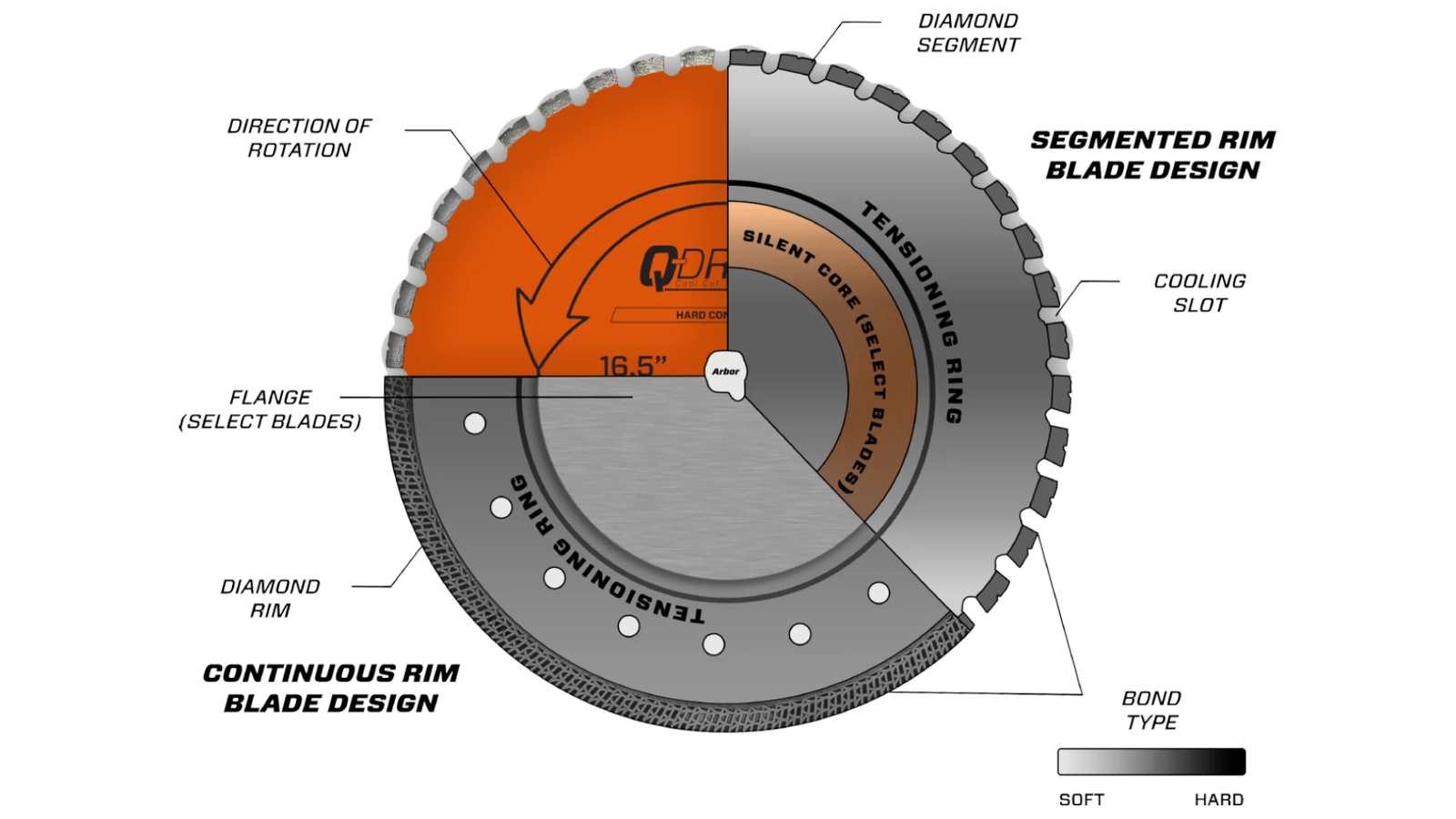
III. What Makes a Great Saw Blade?
Determining whether a bridge saw blade is ideal depends not only on its sharpness but also on its lifespan, durability, and compatibility with the entire bridge saw machine.
1. Processing stability: A good blade should remain stable during continuous processing, without vibration, deviation, or controllable chipping.
2. Matching material hardness: Preventing blade dulling or abnormal wear ensures processing efficiency and system stability.
3. Good matrix strength and dynamic balance: Effectively reduces blade vibration at high speeds, ensuring cutting accuracy.
4. Good heat resistance: Good heat resistance prevents damage or deformation of the blade tip due to high temperatures.
5. Compatibility with the machine. The blade size and speed range must match the processing capabilities of the equipment.
6. Long lifespan. A good blade should have the advantages of stable lifespan and controllable unit cutting cost.
IV. 6 Key Factors When Choosing a Bridge Saw Blade
Choosing the right saw blade is not just a matter of cutting material, but rather a matter of matching the entire bridge saw machine system. Therefore, factors such as spindle power and machining capacity, machine structural rigidity, cooling system, and cutting parameters all influence the bridge saw selection.
The following content includes real customer case shares, which I hope will be helpful to you.
1. Cutting Material
1.1. Cutting Material Types
Different stone materials have different hardness characteristics, including soft, hard, brittle, and abrasive. The table below lists the common materials that bridge saws process, their corresponding hardness characteristics, and recommended saw blades.
Recommended Blade Type Based on Material Types
| Material | Hardness | Recommended Bridge Saw Blade Type |
| Granite | High | Soft bond blade |
| Marble | Medium | Hard bond blade |
| Quartzite | Very High | Soft bond blade |
| Engineered Quartz | High | Soft–Medium bond blade |
| Sintered Stone | Very High | Specialized blade |
| Limestone | Low–Medium | Hard bond blade |
1.2. Cutting Material Thickness
Material thickness directly affects cutting resistance and heat accumulation. Thicker materials require higher cutting tool strength and greater equipment stability. The table below lists recommended bridge saw blades for different materials and thicknesses.
Recommended Blade Type Based on Material Thickness
| Material | Thickness | Recommended Blade Type |
| Granite | ≤20mm | Soft bond blade |
| 20–30mm | Soft bond blade | |
| >30mm | Strong soft bond + Higher segment height | |
| Marble | ≤20mm | Hard bond blade |
| >20mm | Hard bond + Continuous rim blade | |
| Quartzite | ≤20mm | Soft bond blade |
| >20mm | Soft bond + Enhanced cooling | |
| Engineered Quartz | ≤20mm | Soft–Medium bond |
| >20mm | Soft bond + Stable machine support | |
| Sintered Ston | ≤12mm | Specialized blade |
| >12mm | Specialized reinforced blade | |
| Limestone / Travertine | All Thickness | Hard bond blade |
2. Spindle Power and Speed Range
The bridge saw spindle power and speed directly affect the performance of the blades. Insufficient power can lead to unstable cutting, overheating, or abnormal wear, even with the correct blade selection. Therefore, the blades must be matched to the spindle capacity of the equipment. Below is a real case from one of our American clients, which we hope will be helpful to you.
Real Case Sharing –American clients Insufficient Spindle Power on Quartzite
Last March, one of our American clients in the bathroom fixtures industry contacted our after-sales team online. They encountered a problem processing 30mm quartzite slabs, where insufficient spindle power caused the machine to frequently slow down and the blade to slip.
After contacting our after-sales engineers online, Our teams discovered that insufficient spindle power and torque were causing the inability to continuously and stably cut high-density materials. The engineers provided solutions at the time, such as adjusting the spindle speed, reducing the feed rate, and replacing the cutter head with one of the softer bonding agents.

3. Machine Rigidity and Structural Stability
The bridge machine rigidity and structure directly affects the stability of the cutting blades. Insufficient rigidity can easily lead to vibration, blade wobble, and edge chipping. When the equipment stability is low, it may be necessary to select thicker or more vibration-resistant blades. Therefore, blade selection is closely related to the overall structural performance of the machine.
Real Case Sharing: Marble Edge Chipping by German Customers
September 2024, we received an email from a German customer seeking help. They had purchased a bridge saw in China, not from our company, and wanted our assistance. Their problem was severe chipping when cutting 20mm marble using a 15KW spindle power and hard bond blades. They asked if our after-sales team could help.
Although they hadn’t purchased the machine from our factory, we immediately contacted our after-sales team. Our engineers found the cause was a slight deformation of the machine’s crossbeam. They offered solutions such as adding vibration damping supports, reducing the depth of each cut, or replacing the blade with a thicker steel-based one.
Ultimately, we solved the problem for the customer. A month later, the customer reported a 67.3% reduction in chipping and expressed their intention to cooperate with us long-term.

4. Cutting Method and Processing Type
Different processing methods naturally place different demands on the cutting blade. Therefore, the choice of cutting blade should be determined based on the specific processing method.
For example, common processing methods include straight cuts, 45° chamfering, or grooving, all of which produce different stress conditions. Chamfering requires higher stability, while decorative cuts may require a continuous edge structure.
Common Cutting Methods vs. Recommended Blade Type
| Cutting Method | Application | Recommended Blade Type |
| Straight Cutting | Standard slab size cutting | Segmented blade |
| 45° Miter Cutting | Countertop joint processing | Continuous rim blade |
| Step Cutting | Thickness reduction / rebating | Soft or Medium bond blade |
| Slotting / Grooving | Sink cutout / structural slotting | Thin kerf blade |
| Edge Finishing | Decorative edge refinement | Continuous rim blade |
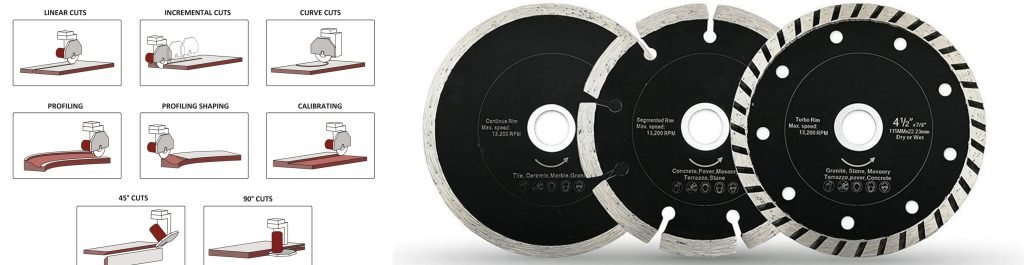
5. Cooling System Efficiency
Cooling efficiency and capacity directly affect the stability of machining operations and the lifespan of the cutting tools. Insufficient cooling capacity can easily lead to high temperatures, tool dulling, or deformation. Therefore, the cooling capacity of the equipment must be taken into account when selecting cutting tools.
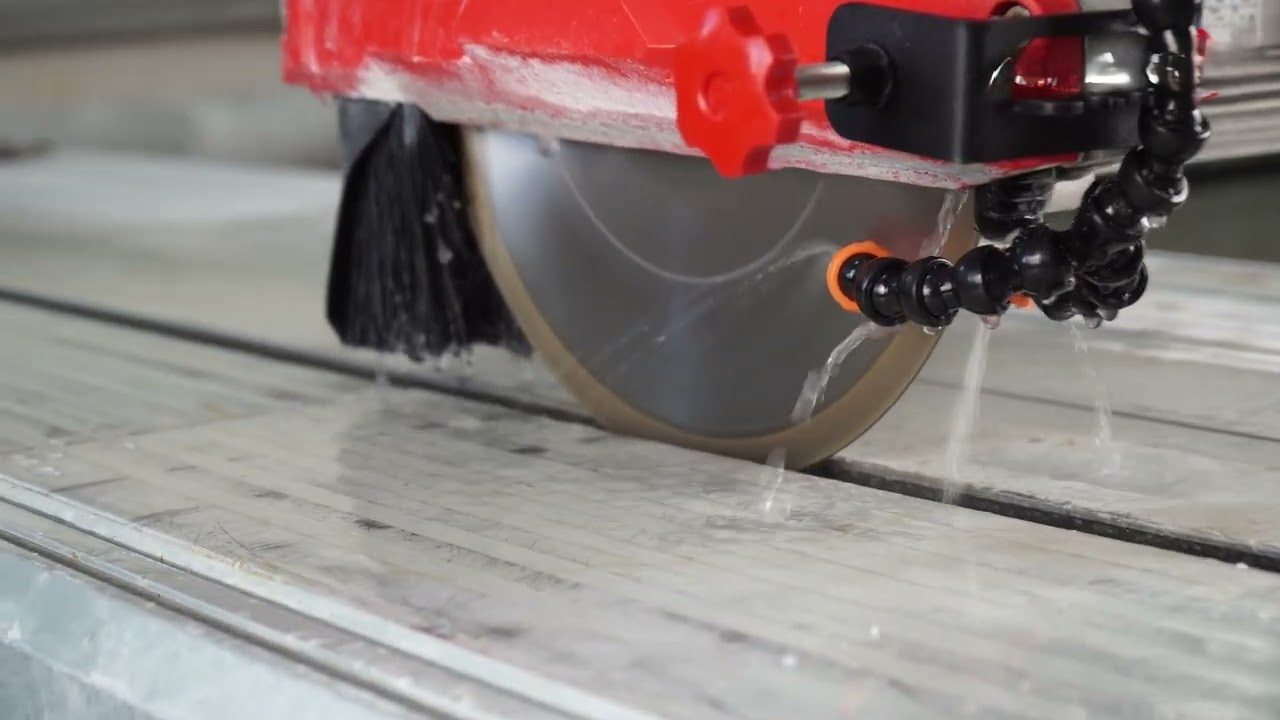
Real Case Sharing – Sintered Stone Overheating by Greece Customers
Last July, an Greece customer who purchased our bridge saw machine contacted us via WhatsApp, saying that their blades were turning blue and softening after continuously cutting 12mm sintered stone slabs, and they hoped we could help. After inquiry by our after-sales team, we learned that they were only using a single water nozzle for cooling, which caused the blade problem and reduced cutting accuracy.
Our after-sales team provided a solution: increase the water supply to both sides and increase the water flow. After implementing the solution, the customer reported that the blade overheating problem was immediately resolved, and the customer also reported that the blade lifespan had doubled.

6. Cutting Parameters
Cutting parameters refer to feed rate and depth, which determine the load capacity of the cutting blade. Excessively high parameters can lead to abnormal tool wear or failure. Therefore, saw blade selection must be comprehensively evaluated in conjunction with appropriate cutting parameters.
Real Case Sharing – Granite Blade Damage by Customers
Last December, our after-sales team received a call for help from a Canadian partner. The customer reported encountering problems such as blade deformation and cracking while machining 30mm granite. After inquiry, we learned the issue stemmed from a mismatch between their cutting parameter settings and the blades.
Therefore, our engineers suggested adjusting the cutting parameters, such as reducing the feed rate, completing the cut in two passes, and maintaining a constant rotation speed. The customer ultimately reported that not only was the blade damage resolved, but blade consumption also decreased by 12.3%.

📚 Further Reading: Complete Your Bridge Saw Knowledge
Now that you understand how to choose the right blade, you might also want to explore:
- Machine Investment Guide – If you’re planning to purchase a bridge saw or upgrade your equipment, check out our detailed price analysis:
👉 How Much Does A CNC Bridge Saw For Marble, Quartz, Granite Cost? - Application Guide: Kitchen Countertop Making – See how to apply your bridge saw and blade knowledge to produce high-value products:
👉 How To Use Marble And Granite CNC Bridge Saw For Making Kitchen Countertops?
V. Bridge Saw Blade FAQs
Q1: How often should I dress my bridge saw blade?
A: When you notice the cutting speed slowing down, you need to adjust it.
Q2: What safety measures should be taken when using diamond saw blades?
A: You must wear protective equipment, inspect the saw blade and protective cover, test run the machine without load, cut at a constant speed, operate from the side, and only approach the machine after it has completely stopped. It is strictly forbidden to use a damaged saw blade.
Q3: What is the typical lifespan of a diamond saw blade?
A: The lifespan of a diamond saw blade depends mainly on the material being cut and the usage. Generally, it can last from tens to hundreds of hours of continuous operation. The harder the material and the more rough the operation, the shorter the lifespan.
Q4: Can the same saw blade be used for bridge cutting of granite and marble?
A: No. Granite is hard and highly abrasive, requiring a high-concentration diamond saw blade with a soft bond; marble is softer, requiring a sharp, medium-hard bond saw blade. Mixing blades will cause chipping and reduce durability.
Q5: How to choose between dry and wet cutting saw blades for bridge cutting?
A: If there is a cooling water supply, wet cutting is preferred due to its longer lifespan, better cut surface, and less dust. If there is no water supply, choose a dedicated dry cutting saw blade, which must be equipped with a dust collector and has a shorter lifespan than wet cutting.
Still have questions about which blade works best for your stone materials? The right blade is important, but it needs the right machine to perform at its best.
🔍 Explore our bridge saw machines:
4 Axis CNC Bridge Saw – High precision for complex cutting and chamfering
5 Axis CNC Bridge Saw – Advanced 5-axis technology for stone processing
VI. Conclusion
As a professional bridge saw manufacturer serving over 2,000 customers worldwide, we firmly believe that superior machining results do not depend solely on individual tools. Our engineers can confidently assure you that when saw blade selection, machine structure, cooling efficiency, and cutting parameters work in tandem, you will not only achieve cleaner cuts but also higher productivity and greater revenue.
If blade problems keep happening or need help choosing the right blade for your Quartz and Granite? Now contact us to get the most professional service and suitable bridge saw blade advice for your bridge saw machine.
You might also like the following related content:
Top 10 CNC Router for Stone Engraving Manufacturers in the World